From $129 to $900+ in 7 months with free Framer templates
How I grew my Framer creator commission from $129 to $900+ a month in 7 months by publishing free templates across multiple categories. Real numbers inside.

Ridham Trivedi
Certified framer expert, 500+ templates sold
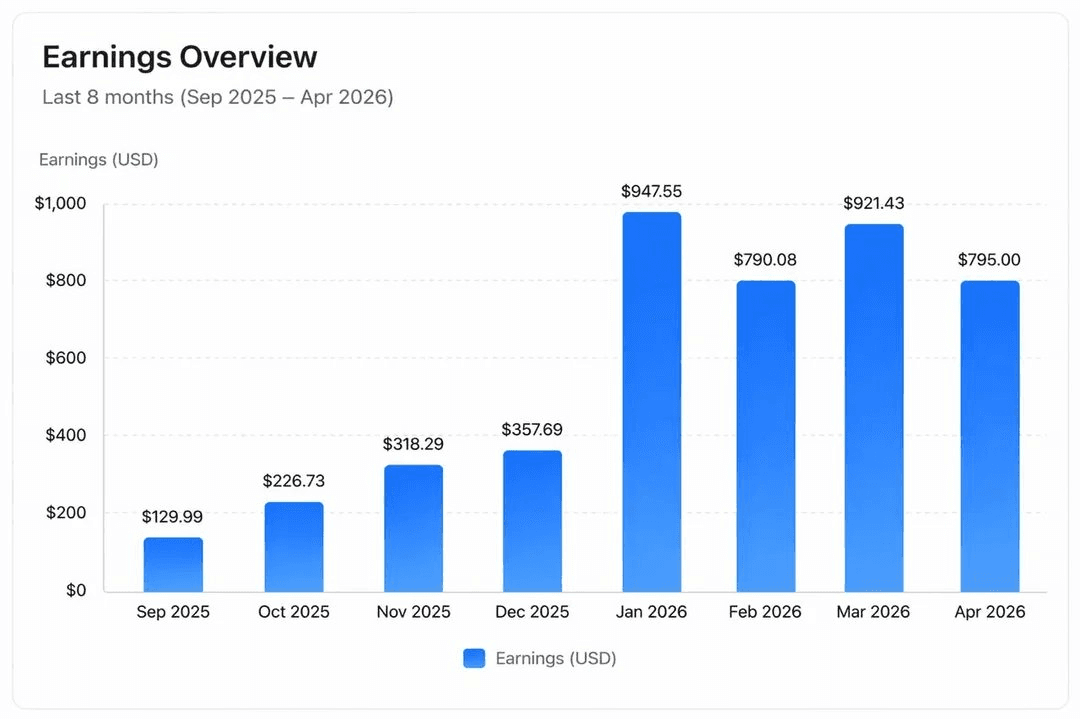
Seven months ago, I published my first free Framer template and earned $129 in creator commissions. This month, I'm at $900+ - and still climbing. No paid ads. No viral launch. No big audience. Just templates, given away for free, that quietly kept earning every month.
Here's exactly what I did, what I got wrong in the first two months, and the two decisions that turned a side experiment into compounding monthly income.
I’m writing this because most of what I read online about “passive income from design assets” is either fantasy or a sales pitch for a course. This is neither. It’s just what actually happened, what I got wrong in the beginning, and the two decisions that changed everything.
If you’re a designer thinking about publishing on the Framer marketplace - or honestly, on any creator-commission platform - there’s something useful here.
What I Got Wrong in the First Two Months
When I started publishing Framer templates, I did what most designers do. I picked a niche I liked, made a few templates in that category, published them on the marketplace, and waited.
Month one: $129. Encouraging, but not life-changing. Month two: barely any growth.
I remember refreshing the Framer creator dashboard like it owed me money. The instinct at this point is to assume the strategy is broken and pivot. Maybe free templates don’t work. Maybe I need to charge for them. Maybe I need to start a YouTube channel about Framer.
I almost did all three.
Looking back, the strategy wasn’t broken. I just hadn’t done enough of it yet, and I’d quietly placed two ceilings on myself without realizing it. Removing those ceilings is the entire story of what happened next.
Lesson 1: One Category Is a Ceiling, Not a Strategy
My first Framer templates were all in the same category. They each competed with my other templates for the same audience’s attention. A user looking for that kind of template might pick one of mine — but they were never going to install two. I was, in effect, splitting one audience across multiple products.
So I started branching out. I made templates for:
SaaS landing pages — startups launching their MVP (several of these ended up in our top 10 free SaaS Framer templates)
Interior design studios — small design firms that need a portfolio site. Those templates, plus the interior design and construction ones, now sit across our roundup of the best free Framer templates.
Hotels and hospitality — boutique stays and short-term rentals
Each one was deliberately aimed at a completely different audience. Different industry. Different aesthetic. Different problem.
Something interesting happened: revenue didn’t just add up linearly. It started behaving differently.
Takeaway: if you’re a creator on any marketplace and your revenue feels stuck, ask yourself whether you’re actually reaching new audiences - or just stacking products in front of the same one.
Lesson 2: Free Is the Distribution Strategy
This one took me longer to internalize, because every instinct I had about pricing said the opposite.
Conventional wisdom: charge for your work. Free templates feel like you're undervaluing yourself. That tension is worth understanding from the buyer's side too - here's what you actually get with free versus paid Framer templates.
What I learned: on a marketplace where you earn commission from usage, free isn’t undervaluing - it’s distribution.
Here’s the math, roughly. A paid Framer template has to convince someone to pull out their card. That’s a high bar. Most people who might have used it will bounce. A free template only has to be good enough to try. The friction is essentially zero. So a free template gets tried by maybe 10x the number of people.
Lesson 3: The Compounding Is the Whole Game
This is the part nobody warns you about, and it’s the part that separates people who make it past month three from people who quit.
The first month feels like nothing. The second month feels like nothing plus a little bit. You start to wonder if you’re wasting your time.
What’s actually happening, invisibly, is this: every Framer template you publish becomes a small, permanent income stream. It doesn’t churn. It doesn’t disappear. As long as it’s live and people are using it, it’s earning. So when you publish your second template, you’re not replacing the first - you’re stacking on top of it. Third template stacks on the first two. Fourth on the first three.
By month four or five, your old templates are still earning while your new ones are ramping up. The curve stops being linear and starts to bend.
What I’d Do Differently If I Started Over
If I were starting from zero today, knowing what I know now about earning from Framer templates:
I’d skip the “find my niche” phase entirely. I’d ship into multiple categories from week one, even if each individual template was less polished. The goal in the first 60 days isn’t to win a category - it’s to find out which categories are even worth winning.
If You’re Thinking About Publishing on the Framer Marketplace
You don’t need a big audience. You don’t need a Twitter following. You don’t need a course on how to make Framer templates.
You need three things:
A marketplace with a recurring commission structure (Framer’s qualifies)
The discipline to ship templates into multiple categories rather than camping in one
The patience to keep going for the two months where it feels like the work isn’t paying off
The compounding is real. But you have to actually be there when it kicks in.
Seven months ago I made $129. This month I’ll cross $900. I’m not stopping.
If you’re at month one and feeling discouraged - you’re in the normal part. Ship the next template